UX Research
Strategy
Conversation Design
AI
MY ROLE
Research: Ethnographic studies, User Needs Validation, Methodology Validation, Research and Testing interviews
Design: Sacrificial Prototypes, Wireframes, Custom GPT for testing, Design System, Stakeholder presentations
PROJECT DURATION
10 weeks
TEAM OF 2
Designer, Researcher
ABOUT
In the United States, marginalized Americans face a growing civil justice crisis—lacking access to legal help for essential needs like responding to evictions, seeking restraining orders, or completing benefit applications.
Frontline Justice, a nonprofit dedicated to addressing this crisis, partnered with us to create a 'platform' that would support, scale, and empower Community Justice Workers (CJWs) (?) who serve on the frontlines of this challenge.
IMPACT
Created the first AI-powered legal co-pilot specifically designed for community justice workers
Developed a validated co-design process for creating hackable tools that can be replicated across different legal domains
Built a scalable platform strategy that centers community needs and peer-to-peer learning
Green-lit development of the prototype tool for full launch
PROCESS
We didn't follow a set process, but rather figured our way through ambiguity to identify what needs to be created to solve the problems we heard about.

Progressive
Immersion

Listening Sessions
with CJWs and Experts

Platform
Ideation

CJW
Testing

Concept
Refinement
EARLY RESEARCH
We kicked things off with a series of 60-minute listening sessions, speaking with experts and CJWs to help us build a clearer picture of the current landscape—what’s working, what’s missing, and where there’s the most potential to make a meaningful impact in community justice.
NEEDS WE HEARD
MINDSETS
The Community Justice Worker (CJW) space needs greater definition to help its practitioners self-identify, bridge silos, and navigate the field.
RESOURCES
For certain kinds of resources, curation may be as valuable as creation.
COMMUNICATION
Facilitate two-way communication channels for conversation and data—both between different kinds of CJWs, and between ourselves and CJWs
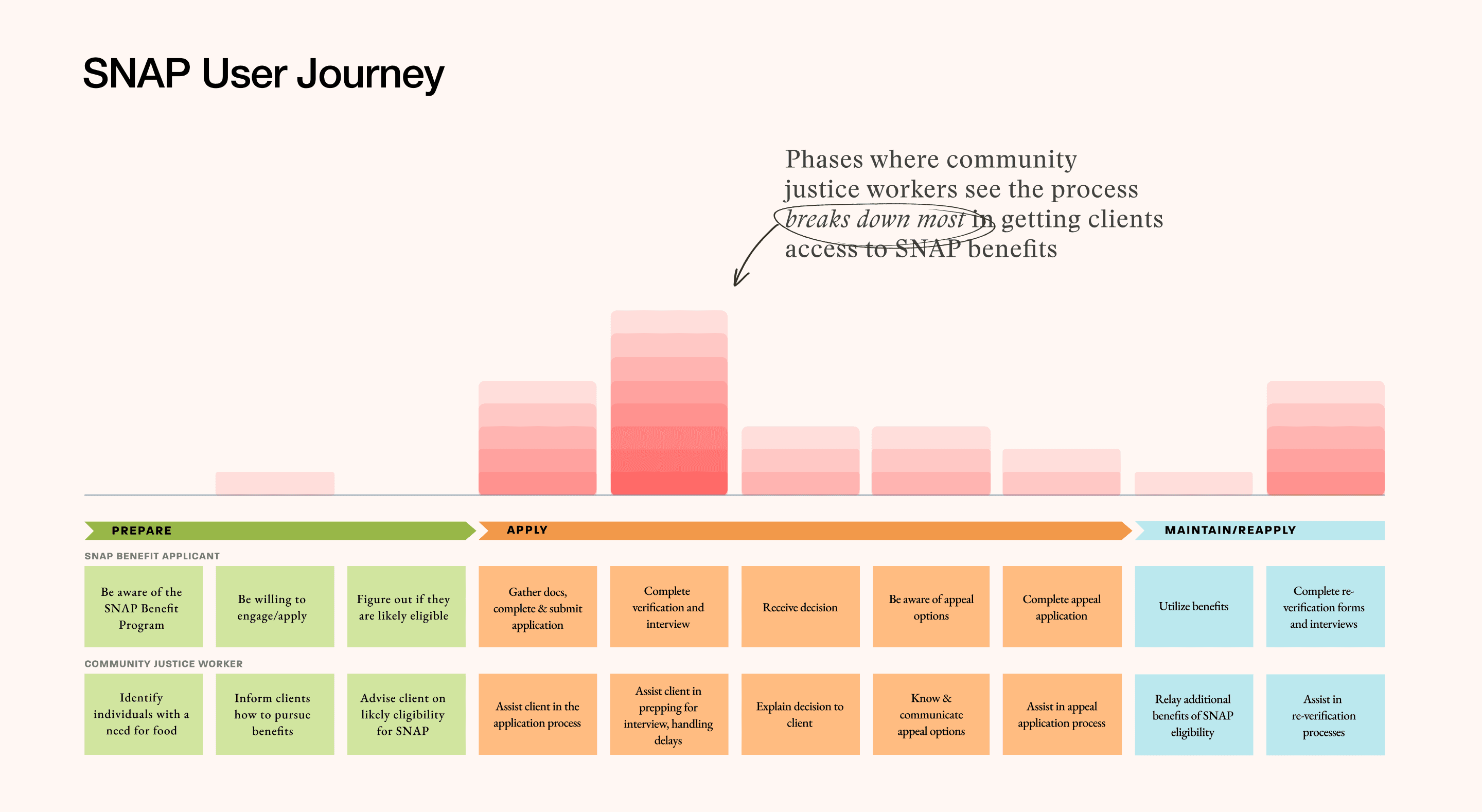
We used the SNAP process as a basis to understand where CJWs face the most issues in the legal delivery process - largely due to the fact that it's an issue that Legal Aid organizations often don't have the resources to tackle but has significant impact on people’s lives.
The Need for Hackable Tools and Community Connection
ADVISORY COHORT
To assemble our advisory cohort for the SNAP tool development, we reached out to CJWs and lawyers with relevant experience through Frontline Justice’s networks and by cold-calling applicable organizations.
Cohort members each participated in remote, one-on-one interviews, helping us gain insight into their unique experiences as CJWs, while incorporated potential concept ideas into the discussions with subsequent participants to get rolling feedback and preferences for promising potential directions for intervention.

MAJOR GAPS
Workers need tools and templates that provide expert guidance without replacing human judgement that can be customized to their specific conditions
CJWs often learn about new tools/hacks through direct interaction with other CJWs but lack a connective tissue for sharing best practices amongst peers

So, we learnt that our platform needs to
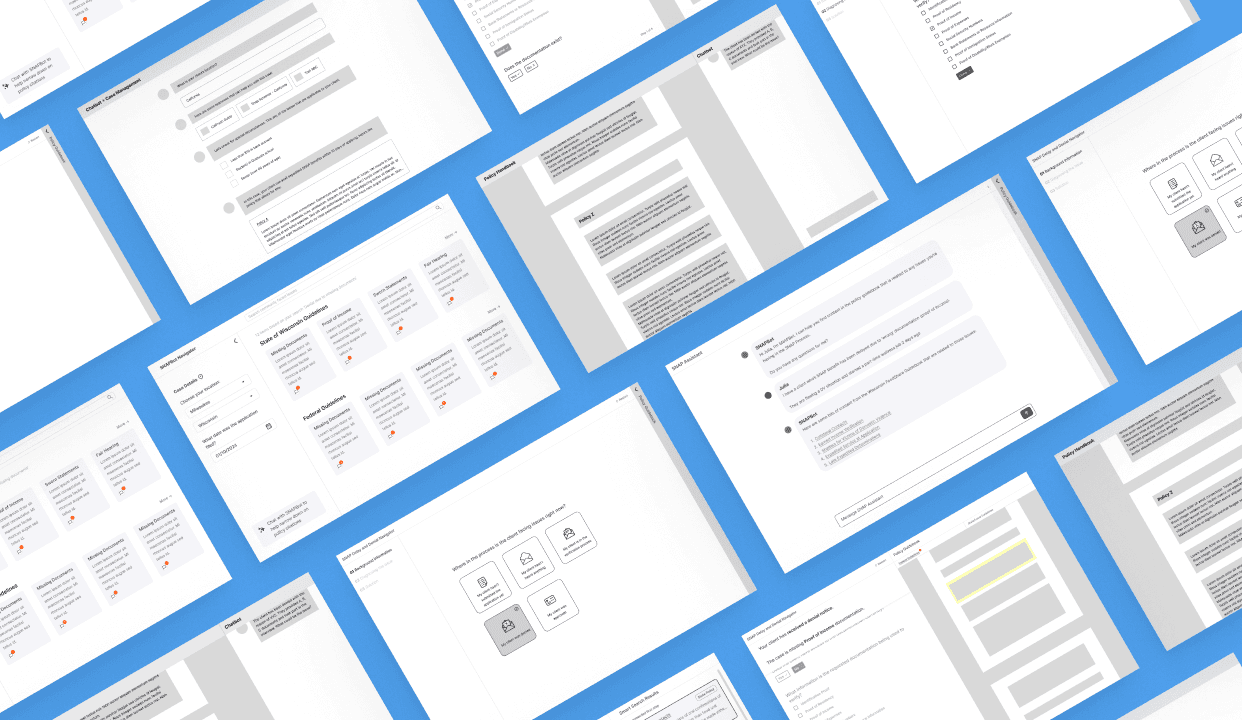
Wireframing:
AI Legal Co-Pilot
We developed a platform strategy centered on two core components:
Hackable Tools: Customizable resources ranging from simple downloadable templates to sophisticated apps that assist with specific aspects of justice work
Community Building: Spaces for justice workers to share best practices, learn from each other, and build the connective tissue the field needs to function more effectively
We then tested them with 6 of the CJWs we had spoken with earlier in our research sessions.
DESIGN PIVOT
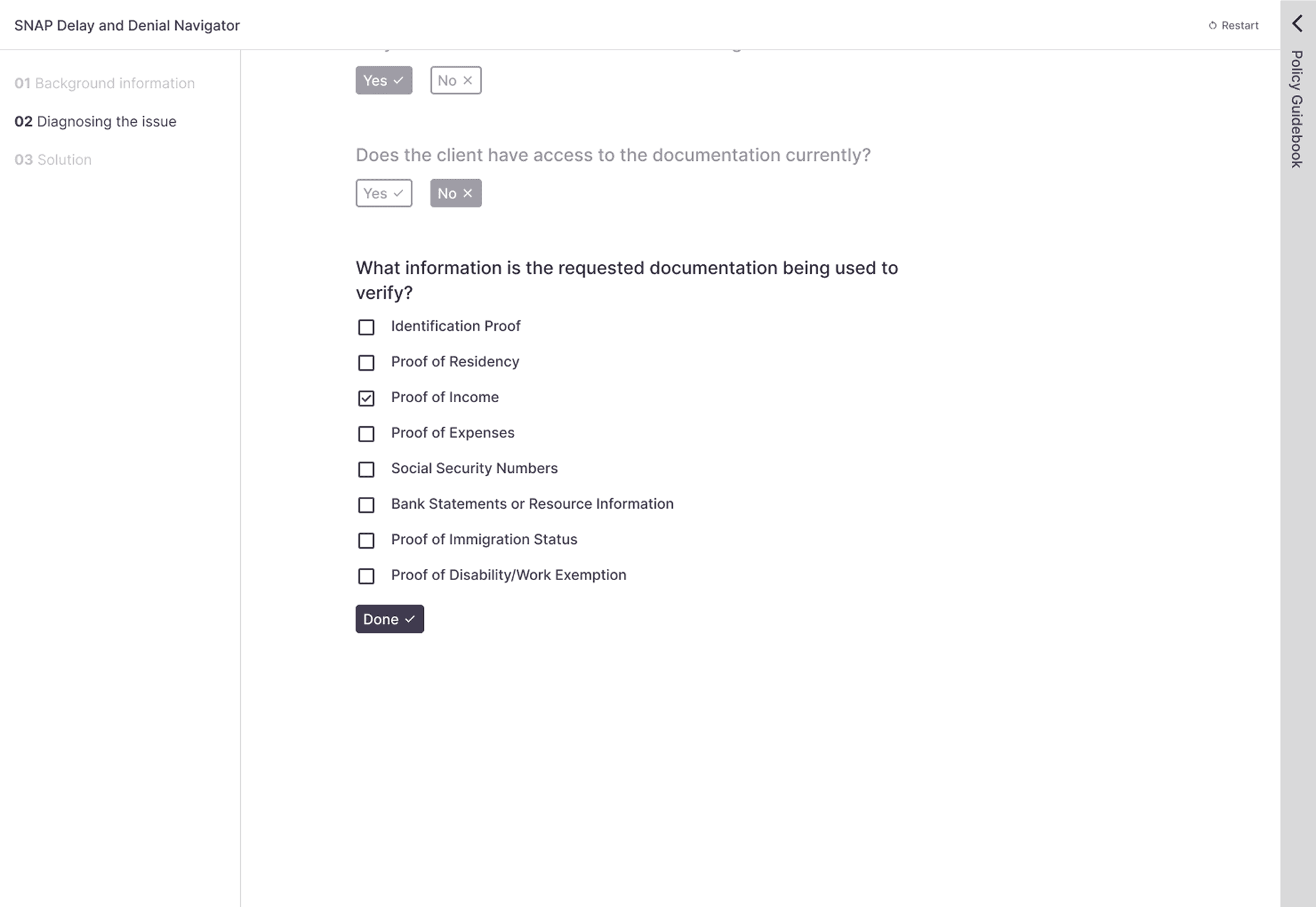
Our initial wireframe directions drew inspiration from diagnostic tools like TurboTax, but we heard from the cohort that the diagnostic questionnaire both triaged issues and provided solutions was too narrow.
CJWs wanted to be able to see a range of possible solutions and be able to use their own intuition to select among them, so we pivoted to a conversational chatbot format that allows for broader inputs and more nuanced guidance.
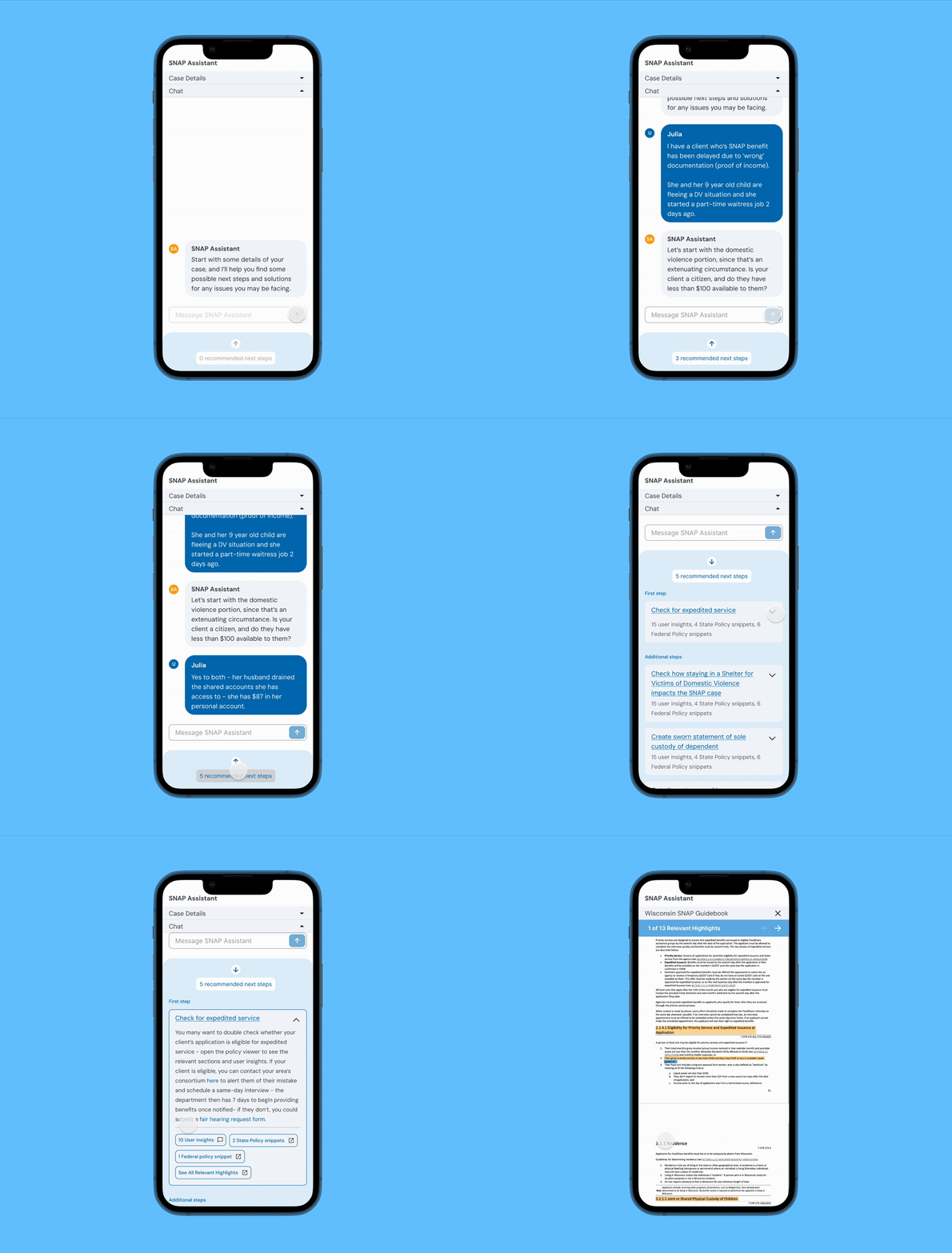
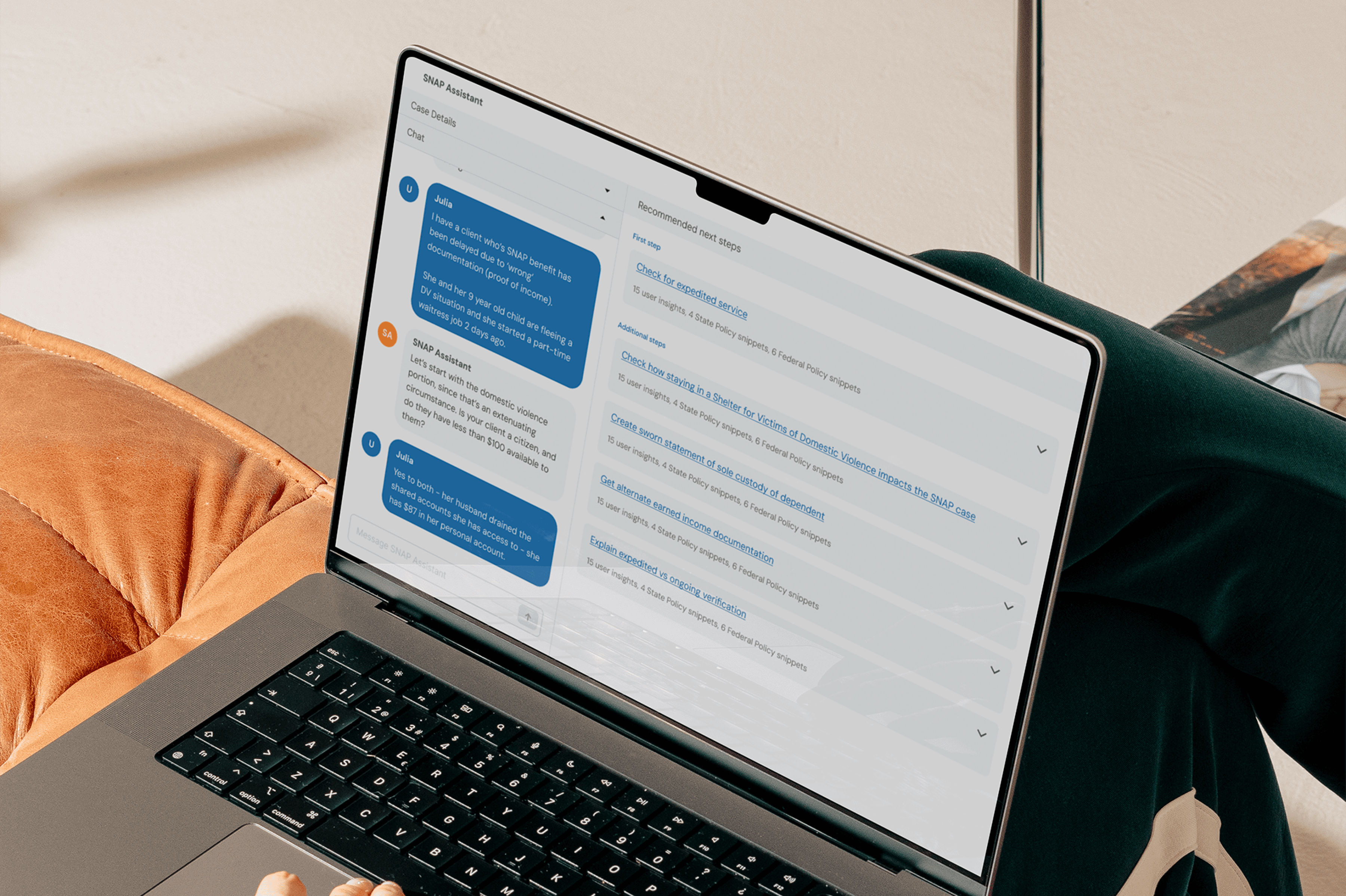
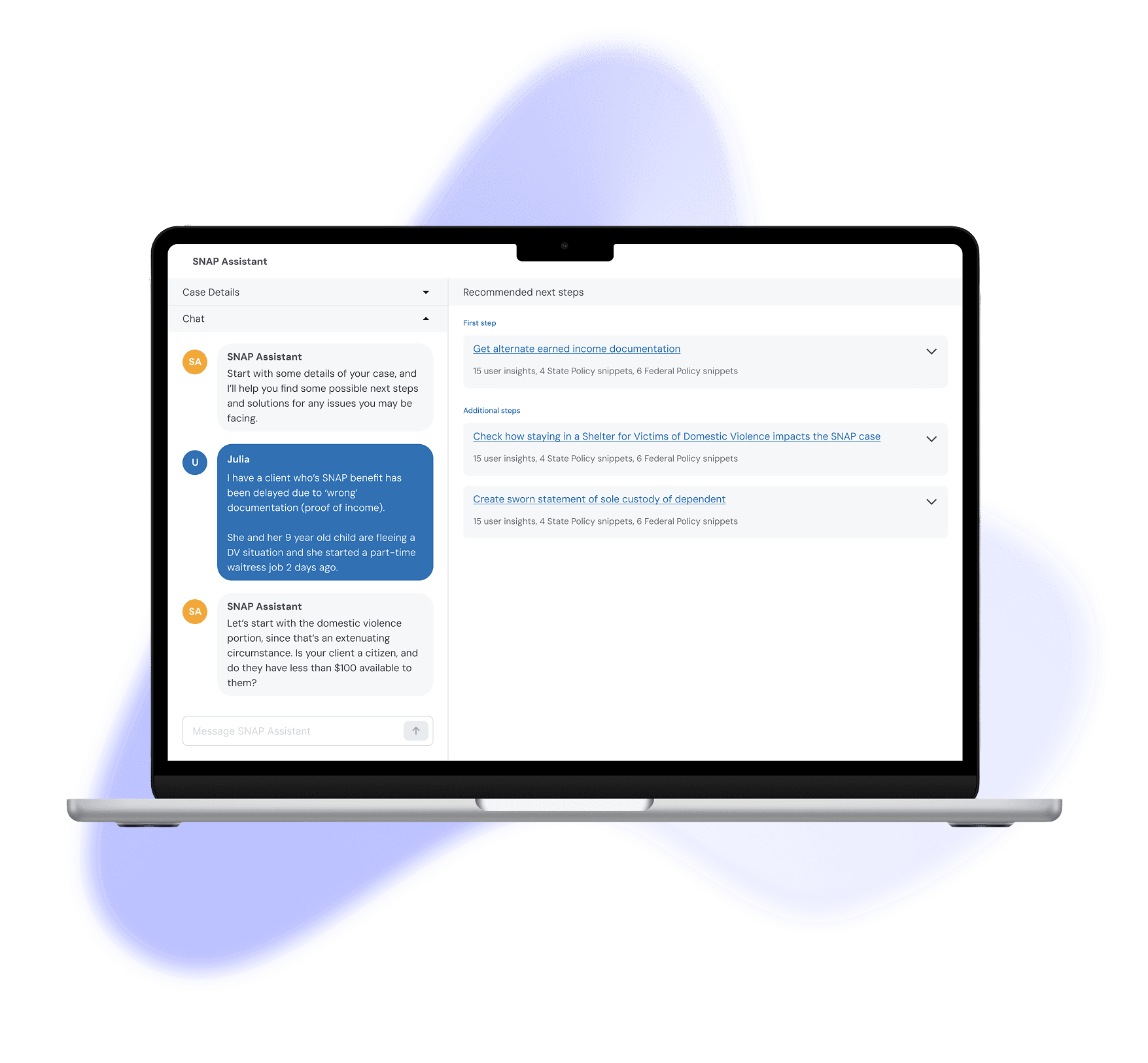
The SNAP AI Co-Pilot
With some back and forth with our cohort of justice workers across different states and roles, we developed an AI-powered assistant that helps workers navigate complex SNAP benefit cases.
The tool:
Combines AI with traditional search to provide reliable, policy-based recommendations
Indexes collaborative expert insights alongside official policy handbooks
Provides clear next-step recommendations that update as more information is added
Maintains full transparency by showing source information for all recommendations and keeping humans in the loop for all critical decisions